The Women Homer Left Behind
“Sing, muse!” says the poet. And the muse complies. This time.
And Christopher Nolan brought The Odyssey roaring back onto the big screen: gods and monsters, warriors, ships, storms, vengeance, and a homecoming—the epic machinery of one of the oldest stories we have.
But before you go sailing off with Odysseus, consider this: What if, instead of watching the heroes march toward glory, we stayed with the women …
… those who waited, who suffered, who commanded wind and waves, who were worshiped as goddesses and reduced to spoils of war?
That is the brilliant premise of Natalie Haynes’ A Thousand Ships. And Haynes tips her hand from the very beginning. She writes:
“Sing, muse.”
But this muse—Calliope—isn’t about to obediently provide the usual epic. She notices the poet’s beautiful gold brooch and decides that if the poet wants her words, the brooch will have to be surrendered. It is a delicious little reversal:
You want me to sing? Fine. But I’m choosing what gets sung.
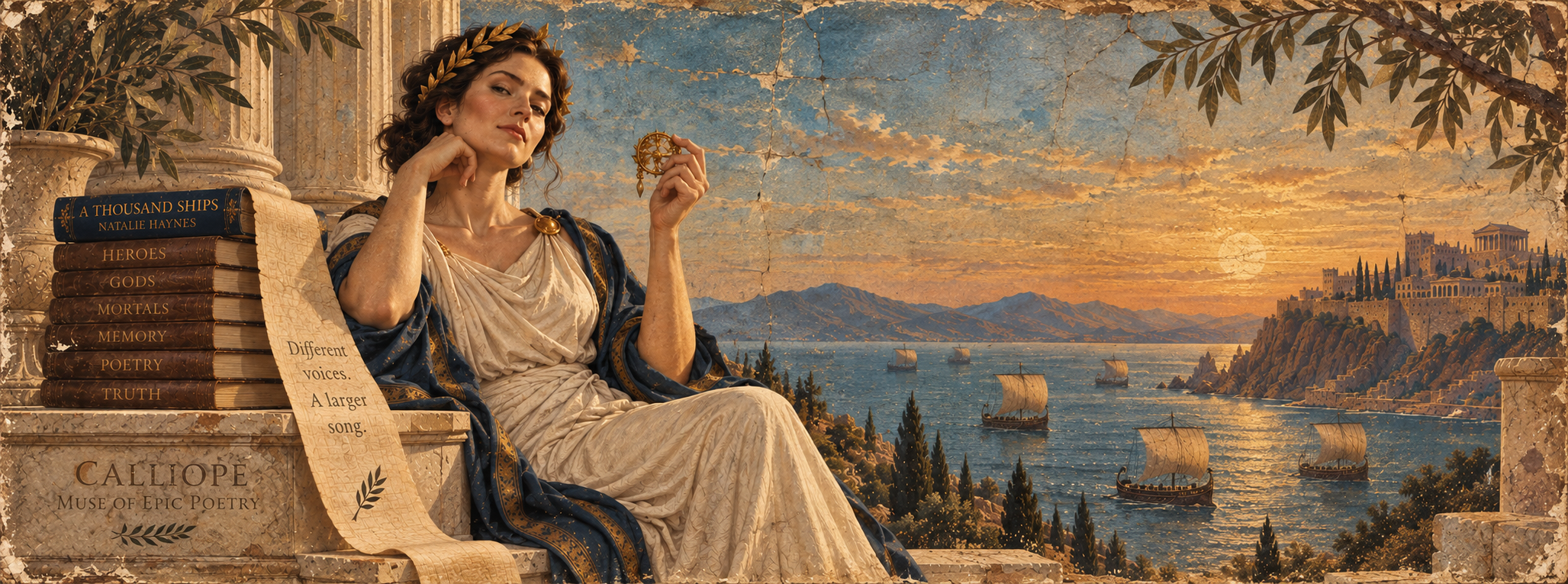
And what she chooses to sing is not another tale of armies and heroes marching toward glory. She turns our attention to the women caught in their wake.
War, after all, is more than stratagems and combat, weapons and mortal wounds. It is loss. Despair. Long stretches of waiting punctuated by unimaginable violence. It is the empty house. The burning city. The person who does not come home.
And these are the territories Haynes gives to her women.
Fasten your seatbelts.
You’ll meet Penelope, wife of Odysseus; Helen, bearing the face that launched a thousand ships; Penthesilea, the Amazon princess; Hecabe (Hecuba), mother of Hector and Paris; Iphigenia, sacrificed by Agamemnon—uh, yes, her father.
You’ll meet them not as ornamental figures orbiting the great men of myth, but as women with histories, desires, fury, tenderness, grief, and astonishingly complicated inner lives.
Haynes gives them the kind of depth that makes a familiar story feel suddenly strange again—as though someone has turned an ancient sword over in her hand and shown us the inscription on the other side.
And then there are the gods.
The Furies, those three terrible goddesses of vengeance and retribution. Thetis, nymph and goddess, mother of Achilles. And Aphrodite, Hera, and Athena, bickering over an apple engraved to the fairest—a divine beauty contest that helped set this entire bloody fiasco in motion.
Because apparently even the Trojan War began, at least in part, with a beauty pageant.
A Thousand Ships takes us deep into the trenches of conflict—not only between nations and armies, but between rivals, lovers, parents and children, duty and desire, and the warring impulses inside the self.
Haynes begins her story at the end.
One woman wakes to an empty house in a city on fire. Troy has fallen. The Greeks are sacking the city. The famous Trojan horse has done its work, disgorging the warriors hidden inside it—among them Achilles and Odysseus.
The ending is the beginning.
From there, we turn back through the ten years of war, as Haynes weaves in the stories of women who have largely been reduced to footnotes in the epic tradition. Their lives intersect and echo one another, each story becoming another thread in an enormous tapestry of war and its consequences.
And here’s where Haynes is particularly marvelous: she never allows these women to become merely symbols of suffering. They are funny, vain, lustful, jealous, courageous, petty, tender, ambitious, terrified, calculating, loving.
In other words, they are human.
I listened to the audiobook, which Haynes herself narrates, and she is so good—so, so good—that I followed her all the way into her podcast, Natalie Haynes Stands Up for the Classics.
A classicist. A novelist. A scholar of ancient Greece and Rome. And a stand-up comedian. And bloody funny.
But back to the book.
What Haynes has done in A Thousand Ships is not simply retell the Trojan War. She has changed the angle of vision.
The old stories have always given us the warriors, the kings, the gods, the heroes. Haynes asks us to look instead at the women who lived with the fallout of their heroism.
The women who waited.
The women who lost.
The women who endured.
The women who survived.
And suddenly, the Trojan War looks different.
Perhaps that is the most interesting thing about returning to an ancient story: the story hasn’t changed. We have.
And sometimes all it takes to make an old epic new again is to move the camera.
Nolan points his toward Odysseus.
Natalie Haynes turns hers toward the women of the war.
Now there’s a journey I want to take.
###
Thanks for reading Butter Side Up! Subscribe for FREE to receive a weekly hit of optimism, grit, and grace.

